
Thursday, February 3, 2011
February 3 - Zechariah 14:6
"On that day, there shall be no light, cold, or frost."
 This morning was not that day.


Monday, January 24, 2011
Sermon for Epiphany 3 A - The Kingdom of Heaven is at Hand to Challenge
I've had a few requests to post yesterday's sermon online. Sober Peasant will recognize much of this, since it's a revision of his sermon from three years ago, and he, in turn gives credit to Eugene Peterson's The Contemplative Pastor for the subversive theme. What doesn't show up in the text is my ad-libbing more stuff about Jesus challenging our way of life.
Peace.
+++

Peace.
+++
This morning’s Gospel is more than just a nice story about Jesus gently starting His ministry. Calls a few followers, heals a few people, does some good. That is the Jesus everybody likes. He is there when I need Him, but does not get in my way. However, this text is more serious than that. Matthew quotes Isaiah 9, and if we better understand Isaiah, we can better understand Matthew’s tone of voice and message.
Those of you here on Christmas day heard the sermon on Isaiah 9 describe Christ’s arrival as being like the day of Midian. God used Gideon and only 300 Israelites, armed with only torches and trumpets, to defeat 120,000 Midianites. As the Israelites hid the torches under clay jars until after they entered the enemy camp, so also the Son of God makes a sneak attack. He hides His divine glory under the clay jar of His human flesh.
The Christmas sermon did not tell you what was going on when Isaiah gave God’s promise. 700 years before Christ’s arrival and rescue, things are going bad for Israel. Assyrian King Tiglath-Pilesar III in 732 BC has just exiled some of the Israelites, as our text says, “In the former time he brought into contempt the land of Zebulun and the land of Naptali” (9:1). But afterward, in the latter time, Isaiah promises that God will restore His captured people. Their joy will be great, like when farmers have a bumper crop, or when the army splits the loot after a victory. Israel will then be as happy as they were 400 years earlier in Gideon’s day, when God defeated the Midianites.
Now, getting back to our Gospel text, when Jesus begins His preaching and healing ministry in the region of Zebulun and Naphtali, Matthew says it fulfills this Isaiah text where an enemy claims God’s territory, and God promises to claim it back for His people. Adding to this warlike context, right before today’s text Jesus has just won a stunning victory over the Devil during the 40 days of Temptation in the wilderness. But as our text begins, the forces of evil fire back, attacking God as King Herod arrests John the Baptist.
And then “Jesus began to preach, saying, ‘Repent, for the kingdom of Heaven is at hand’” (Matthew 4:17). God announces His invasion after successfully sneaking behind enemy lines to claim His territory. But His Kingdom is not marked off on maps of land – for how can a kingdom of land come near? No, His kingdom of Heaven is where He rules and reigns in the hearts of people. Ask yourself: Do I live in my own kingdom much of the week, and the Kingdom of God only part of the week? Do I imagine that I can slip between the two worlds easily, because they peacefully co-exist? Or is your kingdom in danger from this new and invading Kingdom of Heaven?
Yes, it is, for the Kingdom of Heaven is at hand to wage a war, to challenge you, to get in your way of doing what your sin wants to do. The Kingdom of Heaven is at hand to overthrow the Kingdom of Satan, to transfer you out of the domain of darkness and make you a citizen of light under Christ’s authority.
Make no mistake – this is a very real war. A fight for your life. Light invades the world of sin and death to destroy the darkness. As Jesus calls people to follow Him, He recruits Disciples into His battle. He trains them in His ways of combating and overthrowing the dark kingdom. And then Jesus reverses the effects of sin, as He heals and casts demons out, pulling deadly claws out of men’s hearts. The Kingdom of Heaven is at hand.
Do you see it in your own life? If you do not see this battle, then ask yourself if you have surrendered to sin. For the wicked tyrant ruling this world works to keep you in his darkness and make you resemble him in selfishness, bitterness, hatred, lust and greed. Some might say he’s successful at it too.
But the Righteous King Jesus has invaded this world, to overthrow your old sinful nature, and re-create you in His image – the image God originally created you in, before it was lost in sin. The God of God and Light of Light comes to create in you love, joy, peace, patience, kindness, goodness, faithfulness, gentleness and self-control (Galatians 5). This is not easy-going Jesus. This is the Jesus who is deadly serious about bringing you into His Kingdom that you may have life.
That is the true difference between these two kingdoms. The Kingdom of Satan leads only to death. The Kingdom of God promises though you die, yet shall you live. Satan has done a good job convincing us that our lives consist of the things of this world, in power and position, in grabbing glory, in friends and fame in this world. Christ’s light shows that Satan’s lies lead you to destruction.
The Son of God wages His attack so subversively. Instead of sending legions of angel warriors in an all out frontal, visible war on Satan and sin, Christ works in a more hidden way – gaining victory through what looks like defeat at the Cross. Jesus undermines our assumptions, our pleasure seeking, our self-centeredness, our excuse-making, our kingdoms of sin. And He turns us to Himself, one person at a time. Jesus snatches those dead in sin through the waters of Baptism. He preaches His kingdom into enemy hearts. He forces demonic claws out of us through the words of forgiveness. The Lord strengthens His army through the faith of Holy Communion. In all these ways, He breaks into the kingdom of this world – and into each of our kingdoms – to weaken them, undermine them, and triumph over them by the power of His Cross. He kills the old, enemy sinner in each of us and raises a new creature, a child of the light. He carries us on His shoulders out of this kingdom of death through His death. And Christ brings us into His Kingdom of Heaven through His resurrection from His tomb. In this way the Lord of life establishes His Kingdom and builds His Church.
Faith in the forgiveness of sins re-orders our priorities. Thus, instead of trying to lead the way, we follow our King in His Kingdom – though that looks a bit different for each of us. Some, as we heard today, are called to be “fishers of men” – and some God calls to other tasks and vocations. But no matter who you are, all Christians follow in the life God gives us – because He has raised us from the death of our sins to a new life in Christ. We follow because He has given us victory over our graves by His Cross. We follow because His Spirit strengthens us to turn from our old life and ways in repentance, for the Kingdom of Heaven is at hand.
He has recruited us into His subversive army. Our weapons are not bombs, guns or knives, but the Sword of the Spirit, which is the Word of God. We bring His Word’s light and life into dark places. Battlefields of sin and death. It might be very dark where you are. And your little light may not seem like much. But remember, it is not left up to you. For you are following where Christ leads. Which means He goes there ahead of you. He brings you along. That He would work in you, with you, and through you, subversively slipping past the defense of others, to bring His Kingdom and life to all.
That is, after all, what we ask our Father to do in the Lord’s Prayer when we beg, “Thy Kingdom come.” And as it comes, we also pray, “Lead us not into temptation.” In other words, Father, give us eyes of faith to see the battle the way You see it. To see sin’s traps, and to see our Savior. Keep us from being deceived or misled into false belief, despair, or other great shame and vice (SC, 6th Petition). Bring us to repentance as You, Father, deliver us from evil. Establish us firmly and securely in the Kingdom of Your Son, whom You love, Your kingdom of life which has no end. For only You can do it.
As surely as Jesus went into the regions of Zebulun and Naphtali, so also Jesus comes to you here. His same powerful word is here for you. His same forgiveness here for you. His same body and blood that once walked those roads until He hung on the Cross now comes here for you. That you may be His own, and live under Him in His Kingdom, and serve Him in everlasting righteousness, innocence, and blessedness (SC, 2nd Article). Amen.
Wednesday, January 19, 2011
January 19 - Writing
wow. just wow. Read the writing for today if you have not already. Taking the name of god away from that which is not god. wow. Quite fitting for the Ezekiel reading, and, somewhat less directly, for the Romans 9 text.
Tuesday, January 18, 2011
Not TDP - Newspaper devotional article
a revision of Rev. John Pless' sermon to Lutherans before the national March for Life January 2010:
We can honestly say a deep darkness has come upon our world – and it seems to be getting deeper. Floods, earthquakes, tornadoes, wars around the world and gunfire erupting in our own land cut life short. The deaths you hear about on the news is staggering. But that amount is eclipsed by a far larger number the news does not report – the number of unborn babies whose lives have been cut short by abortion since the passing of Roe vs. Wade on January 22, 1973.
However, the good news is that the God of Light works against the darkness. He raises up people who do not just sorrow over or speak out against abortion, but actively support the cherishing of life. Places like the Sparta Crisis Pregnancy Center and the Life Network in Waterloo help pregnant women to choose life for their babies.
When Christ starts His preaching the Gospel and healing, Matthew says this fulfills Isaiah 9, “‘The people dwelling in darkness have seen a great light, and for those dwelling in the region and shadow of death, on them a light has dawned.’ From that time Jesus began to preach, saying, ‘Repent, for the kingdom of heaven is at hand’” (Matthew 4:16-17).
The Lord calls us to repent because the darkness is not only out there in the hearts of gunmen, or doctors who use the gift of medicine to destroy the life of the unborn. Repent, because the wickedness we hide in the shadowy parts of our heart is known by the God of Light. Repent of failing to speak and act to help the weak who cannot defend or speak for themselves. Repent of looking the other way when the darkness comes. Repent of making the darkness deeper.
We are not saved by our morality, no matter how many despicable evils we are against. Only Jesus saves us. Only His perfect life and innocent death earns the Kingdom of Heaven for us. Only His blood cleanses us from all our unrighteousness. Only His Light scatters our darkness. As Christ forgives you, the words of Isaiah 9:2 come true for you: “The people who walked in darkness have seen a great light; those who dwelt in a land of deep darkness, on them has light shined.”
We can honestly say a deep darkness has come upon our world – and it seems to be getting deeper. Floods, earthquakes, tornadoes, wars around the world and gunfire erupting in our own land cut life short. The deaths you hear about on the news is staggering. But that amount is eclipsed by a far larger number the news does not report – the number of unborn babies whose lives have been cut short by abortion since the passing of Roe vs. Wade on January 22, 1973.
However, the good news is that the God of Light works against the darkness. He raises up people who do not just sorrow over or speak out against abortion, but actively support the cherishing of life. Places like the Sparta Crisis Pregnancy Center and the Life Network in Waterloo help pregnant women to choose life for their babies.
When Christ starts His preaching the Gospel and healing, Matthew says this fulfills Isaiah 9, “‘The people dwelling in darkness have seen a great light, and for those dwelling in the region and shadow of death, on them a light has dawned.’ From that time Jesus began to preach, saying, ‘Repent, for the kingdom of heaven is at hand’” (Matthew 4:16-17).
The Lord calls us to repent because the darkness is not only out there in the hearts of gunmen, or doctors who use the gift of medicine to destroy the life of the unborn. Repent, because the wickedness we hide in the shadowy parts of our heart is known by the God of Light. Repent of failing to speak and act to help the weak who cannot defend or speak for themselves. Repent of looking the other way when the darkness comes. Repent of making the darkness deeper.
We are not saved by our morality, no matter how many despicable evils we are against. Only Jesus saves us. Only His perfect life and innocent death earns the Kingdom of Heaven for us. Only His blood cleanses us from all our unrighteousness. Only His Light scatters our darkness. As Christ forgives you, the words of Isaiah 9:2 come true for you: “The people who walked in darkness have seen a great light; those who dwelt in a land of deep darkness, on them has light shined.”
Tuesday, January 4, 2011
January 5 - Luke 2, Jesus in the Temple
So, at the time of the Passover, Jesus gets chewed out after doing the righteous thing - the Father's will.
Praise be to God through our Savior Jesus Christ for His indescribable grace.
- at 12 years old by His mother.
- and around 20 some years later at the Cross by His religious and secular authorities - and Father.
Praise be to God through our Savior Jesus Christ for His indescribable grace.
Saturday, December 4, 2010
December 3 - What others said
What this collect (prayer) reminds me of so beautifully is that God’s protection rescues me from my sins. No matter how badly I have screwed up. No matter how much I have contributed to all of my own problems, God is there for me. We pray that God would stir up His power to rescue. And God loves to answer prayers more than anything else.In case Todd Wilken orJeff Schwarz come across this post of mine (and somehow miss Rev. Pepperkorn's) - I know Lutheran Logomaniac doesn't have an Issues, etc. Widget. But I do, and so you could consider bending the rules and awarding his post Blog of the Week through mine.
Monday, November 29, 2010
November 29 - Isaiah 5
O Lord, if You must take down our wall of protection due to our sin, may it result in our discipline rather than our destruction. May the cross You lay upon us result in the sweet wine of patience, faith and mercy.
Saturday, November 20, 2010
November 20 (Anniversary of my Baptism) - Psalmody
 Image via Wikipedia
so that I may enter and give thanks to you eternally.
My baptism served as Your gateway to my life of righteousness, innocence and holiness with Your Son forever.
I thank You for Your promise to answer my prayers always;
not just to rescue me, but to be my salvation.
Though the builders rejected Christ,
He has become the cornerstone my life, the life the whole Christian Church is built upon.
This is Your doing, O LORD, as You build Your Church upon the confession of faith;
it is marvelous in our eyes.
This is the day that You, O LORD, have made;
let us rejoice and be glad in it.
Save us, we pray, O LORD!
O LORD, we pray, give us success!
You blessed me to come to You in Your name - of Father, Son and Holy Spirit!
And not just me, but a great multitude from every nation - so that we may bless You from the house of the LORD.
The LORD is God,
and You have made Your light, Jesus Christ, to shine upon us and deliver us from the domain of darkness.
Bind the festal sacrifice with cords,
up to the horns of the altar!
You are my God, and I will give thanks to You;
You are my God; I will extol You.
Oh give thanks to the LORD, for He is good;
for His steadfast love endures forever!

Tuesday, November 16, 2010
Wednesday, November 10, 2010
November 10 - Jeremiah 23
In the midst of the condemnation of the priests who failed to shepherd and the Parable of the Talents - both texts doing their Law work of laying me low - there was this strengthening word that lifted up my head (Psalm 24:7ff) so that I might rejoice in the coming of my King, David's righteous branch:
The LORD is our righteousness. (Jeremiah 23:6)
That is His name, the one who has come and will come again to save me and the rest of His people from their sins. Amen.
The LORD is our righteousness. (Jeremiah 23:6)
That is His name, the one who has come and will come again to save me and the rest of His people from their sins. Amen.
Friday, November 5, 2010
“I feel hollow and empty, do I have to begin all over again?” A Letter of Spiritual Consolation
Wise words of spiritual consolation from Rev. Paul McCain that worked to lift my lowly heart today.
Thursday, November 4, 2010
November 4 - Matthew 22
As the Law proclaims a second commandment to the great and first one, namely that you are to dress your love for God with words and deeds for your neighbor,
the Gospel proclaims that God has dressed His love for you with the saving words and deeds of the Christ, flesh and blood of David as His Son, yet David's Lord.
As the Pharisees try trapping Jesus with a Law question, so He works to trap them and us in this intriguing Gospel question.
the Gospel proclaims that God has dressed His love for you with the saving words and deeds of the Christ, flesh and blood of David as His Son, yet David's Lord.
As the Pharisees try trapping Jesus with a Law question, so He works to trap them and us in this intriguing Gospel question.
Reasons to Pray When You are Slow and Lazy About Prayer
Chemnitz' list is well worth your time (HT: Paul McCain)
Wednesday, October 27, 2010
October 27 - again what others are saying
a year ago, I suggested people read what Pr. Weedon wrote about today's readings. That's still good advice.
Tuesday, October 26, 2010
October 26 - Matthew 18 prayer
O Lord, out of the mouth of babes and infants You have established strength because of Your foes, to still the enemy and the avenger. Your Son bids children to come to Him, for the kingdom of God belongs to them. Let us not despise children but be prepared to bring parents and children to baptismal instruction, catechesis, and the very Word of God, that they may read, mark, and learn of Jesus, their Savior.
(from "Let Us Pray" email for October 24 - based on Luke 18, but applicable here.)
(from "Let Us Pray" email for October 24 - based on Luke 18, but applicable here.)
Saturday, October 23, 2010
October 23 - Deuteronomy 24-25
God's mercy for the poor and disadvantaged as expressed in this section of Deuteronomy's Law is good to read on the day of St. James of Jerusalem. But my mind wandered to how God was preparing in advance for the good works done in Ruth's day. Boaz had this Law guiding his farming, therefore Ruth and Naomi did not starve, therefore Boaz not only became Ruth's kinsman-redeemer, but this union also eventually led to the birth of David - and far more importantly, the birth of the Son of David, the Christ, the Son of the living God, who became poor for our sakes that we might become rich.

Friday, October 22, 2010
October 21 - Deuteronomy 20
I've been thinking along the lines of smallness and weakness lately as I see numbers and strength dwindling, so as I read Deuteronomy 20, I saw more than just rules for how Israel would fight its wars. I saw the new Israel, being opposed by Satan's army with the powerful weapons of unbelief and lies and true accusations of our own betrayals of the Lord. The enemy forces are larger than we are as the Church. We are outmanned and outgunned. On earth is not his equal. But for us fights the Valiant One. Therefore, "you shall not be afraid of them, for the LORD your God is with you, who brough you up out of the land of" your slavery to sin (Deuteronomy 20:1). David vs. Goliath wasn't the only "David vs. Goliath" battle Israel (Old or New) faced/faces.
I am thinking it is worth looking at the vocation of pastor in light of the priest's task before battle, telling the congregation that the LORD goes ahead of them in their week, in their life, to give them the victory as they struggle not against flesh and blood, but against the spiritual forces of evil. In this way, those nearing death can speak as confidently as Moses ("When [not if] the LORD your God gives it into your hand..." verse 13) and Paul (2 Timothy 4:7 - "I have fought the good fight... there is laid up for me the crown of righteousness, which the Lord, the righteous judge, will award to me on that Day, and not only to me but also to all who have loved His appearing.")
I am thinking it is worth looking at the vocation of pastor in light of the priest's task before battle, telling the congregation that the LORD goes ahead of them in their week, in their life, to give them the victory as they struggle not against flesh and blood, but against the spiritual forces of evil. In this way, those nearing death can speak as confidently as Moses ("When [not if] the LORD your God gives it into your hand..." verse 13) and Paul (2 Timothy 4:7 - "I have fought the good fight... there is laid up for me the crown of righteousness, which the Lord, the righteous judge, will award to me on that Day, and not only to me but also to all who have loved His appearing.")
Lord Jesus Christ, clothe us, we pray, with the whole armor of God that we may stand firm in every assault and never lose sight of Your victory on our behalf at the cross and empty tomb. Amen. (The Lutheran Study Bible, pg. 310.)btw, having read through TDP a time or two now, as I've repeatedly come across the writings by Valerius Herberger, I've gone from "Wow, that was good," to "Who is this guy?!?!?!?" In case you've shared similar thoughts check out this blog post on this new book from CPH.
Monday, October 18, 2010
October 18 - St. Luke
Thank You, O God, for the beloved physician St. Luke, whose Gospel shows the Healer of the nations who shares our woes. (HT: Horatio Bolton Nelson, LSB 518, st. 26)
Sunday, October 17, 2010
Sermon for Oct 17 - Luke 18:1-8 illustrated by Psalm 13
 (Most of this comes from Is God Listening? by Andrew E. Steinmann. The Judgment Day image is based on the Luke 18 meditation in Selected Sermons of Norman Nagel. For many and various reasons, this is the sermon I needed to preach (and hear) today as these texts describe the location of my life pretty precisely. And I give thanks to God for those congregation members and blog readers who pray for me and do not lose heart. It is only by God's mercy that I am still going. To Him be all glory.)
The Lord tells the parable of the persistent widow for the same reason that He inspired David to write down Psalm 13 – “to the effect that [we] ought always to pray and not lose heart.” Daily frustrations make it so easy to lose heart, to give up on the struggle. Your disappointment over things going wrong spills over into angry words and actions towards innocent bystanders – like the guy who kicks the dog when he gets home from work because he can’t kick the boss who wronged him.
Naturally we think the best thing to do is to swallow our pride and our anger, pretend it’s not there – better than dumping on God. Yet it might surprise you that in fact God invites you to dump your frustrations and anxieties on Him – to admit to them and pray for Him to save you from the wrong done to you. That is the way of faith, to stop lying about how you are doing and instead be open and honest with God. So you try to pray, but the evil problems remain. Worse yet, we see the Lord answering other people’s prayers speedily. Those ten lepers last week cried out to Jesus for mercy and got to go back healed to their families that very day! When you do not see any change for the better, it can feel like prayer has become useless. As if God is deaf, or at least refusing to hear you. Prayer exercises our patience. You are talking to the Lord for whom a day is like 1000 years, and 1000 years like a day. This might take a while [HT: William Cwirla].
The Lord knows that impatience tempts us to respond horribly with “false belief, despair and other great shame.” Concerned about this danger, Jesus wonders out loud if He will find faith on earth when He will come to be our judge. To make sure there is faith on that Day, Christ teaches us not to lose heart when dumping our complaints on God – using the parable of the persistent widow crying out for justice and using Psalm 13 – and at least 40 other psalms and parables like these. Take a look at prayers in the Bible and you will find you are not alone in feeling like God is not paying attention.
That is exactly were David is at. You know David, the man after God’s own heart and the King of great faith. In Psalm 13 his faith does not sound so strong as he confronts the God who seems to be ignoring David’s troubles, like an unrighteous judge who does not respect the innocent. “How long, O LORD? Will You forget me forever? How long will You hide Your face from me?” (Psalm 13:1). This is a prayer of never-ending hopelessness and eternal hope at the same time. That may seem strange to have both of those going on in the same Psalm, but that is the way it is with us. Each Christian has sinfulness and holiness going on inside of us side by side. Our thoughts are always going to be strange mixes of pure and impure motives until that Day our Lord purifies and perfects us in Paradise.
Overwhelmed by earthly troubles, David feels abandoned, with no Divine direction. “How long must I take counsel in my soul?” (13:2). Hopelessness turns to desperation as he demands God’s attention. “Consider and answer me, O LORD my God!” (13:3). David feels like he is on the brink of death. And that tragedy would make his enemies happy, as if they were right to make David miserable.
Psalm 13 could be prayed by anyone who has suffered loss – and you all have, some losses more serious than others. Lost health, lost income, possessions and reputation, lost family members and friends. The thought of never being able to get back what was lost can devastate even the strongest people. The pain leads to asking David’s question. How long? Will God make me suffer the rest of my life? Will I ever get life back to normal? We get caught in a tug of war between our hearts and minds - our hearts wanting to go back to the way life used to be, our brains knowing that will never happen again.
But remember that Psalm 13 is a prayer of hopelessness AND hope. Hope that comes from faith. The faith that always receives the strength and mercy that Christ gives. In faith, we trust that everything that happens is under the Lord’s control – that God works all things together for the good of His people, as Romans 8:28 teaches. All things – even the losses and frustrations we suffer, God will turn around to be a blessing in His time. For as much as Psalm 13 demands that God quit hiding and start listening, this prayer still trusts that there is love in God’s heart – a steadfast love, a mercy that endures forever. It can be nothing but mercy, as you consider the Ten Commandments and all the things in your life that tell God you really do not love Him as much as you should, all the sins that anger Him, all your evil that according to strict justice would land you and me in Hell.
Yet God’s love for you is steadfast – it does not run hot and cold depending on how we deal with Him. His love does not treat us as our sins deserve, but has made “you wise for salvation through faith in Christ Jesus” (2 Timothy 3:15) as you have listened to the sacred Scriptures. The judge in the parable did not want to be bothered by the widow. But the One who is your eternal and almighty Judge – He is so bothered that He goes to the Cross for you. God’s anger against our sin was done there. It is finished, so that eternal judgment can no more bring us to condemnation. The Son of Man who was on the cross to save us from our impatience, our anger and frustrations, our false belief and despair, the Son of Man who prayed for your faith on earth and now makes your prayers to be heard in Heaven, this same Son of Man will be our judge at the end of time. When we stand before the Lord, then it will be clear how tenderly and generously He has brought you through all these dark times when it all goes wrong. We will then see God’s delays, when it looked at the time like He did not care, are really part of His wanting your good – or working for the good of others around you, giving you stronger faith in preparation for larger salvation gifts.
When David first wrote Psalm 13, he knew his opponents were happy to see David hurt. But, at some unknown day in the future, David’s “heart shall rejoice in [God’s] salvation” (13:5). Even though the vindication might not be the way he imagined God would save him, David trusts God’s plan for rescue from his despair is the best. This turns the Psalm from desperate, hopeless cries to grateful praise. Before he says his “Amen,” God has changed David as he knows the answer is in God’s steadfast love and goodness.
That is where all our prayers find their strength – trusting in God’s promises that He is good and merciful. Prayers are not strong because we get them prayed tons of times, pestering God until He listens. Jesus in today’s Gospel does teach us to pray often – but not because that will make God pay more attention. Prayer is not the same as calling God on the phone and letting it ring and ring and ring until He gets annoyed and answers. Instead, continuing in prayer is an expression of our continuing trust in God. Despite any and all appearances of God being deaf to us and caring little for us, continuing prayer shows we know the Lord’s mercy – that He will do good for us though we do not deserve it.
The same faith David had in God’s gracious promises is the same faith that God gives to each of us in our Baptism. That’s why we rejoice like David did in God’s salvation. Because “it is your Father’s good pleasure to give you the kingdom” (Luke 12:32), the Lord has come into this world as the Son of David. Jesus Christ never once lost heart, but perfectly feared God and respected man all the way to the Cross. Before His death, He prayed that God would forgive sinners and remove the cup of suffering from Christ. And it turned out that it was God’s will to remove that cup and give His innocent Son justice – though the answer to Christ’s prayer came after a delay of three days done for your good. But then suddenly, in a twinkling of an eye things changed as the darkness of Christ’s tomb was scattered by the light of Easter Day. Justice was done as the Christ who was murdered is alive again. All the sorrows, losses, angers and frustrations this world threw at Jesus – God the Father saved His Son from them all. And, in the end you will sing to the LORD, for He will do the same for you. Amen.
Saturday, October 9, 2010
Oct 9 - Responsory
Oh, fear the Lord, you His saints, for those who fear Him have no lack!
Fear God and keep His commandments, for this is the whole duty of man.
Send out Your light and Your truth; let them lead me!
Fear God and keep His commandments, for this is the whole duty of man.
Glory be to the Father and to the Son and to the Holy Spirit.
Fear God and keep His commandments, for this is the whole duty of man.
It's nice how the responsory today sings the faith of the Scripture readings. Lest we forget God and His merciful goodness, it reminds us that we have no lack because He has given to us all the physical blessings we have (Deuteronomy 8). You have no lack because the Father who numbers the hairs on your head values you more than many sparrows (Matthew 10:30ff). You have no lack because He has sent out His light and truth through those who acknowledged Him before men - before YOU - and you have received Christ through them. You have no lack, because though your skin will be destroyed, yet in your flesh you will see God - as the Righteous One, Jesus Christ was destroyed in both body and soul on the Cross and rose again so that you could be led to receive the Righteous One's reward at the Last Day's resurrection.
Fear God and keep His commandments, for this is the whole duty of man.
Send out Your light and Your truth; let them lead me!
Fear God and keep His commandments, for this is the whole duty of man.
Glory be to the Father and to the Son and to the Holy Spirit.
Fear God and keep His commandments, for this is the whole duty of man.
It's nice how the responsory today sings the faith of the Scripture readings. Lest we forget God and His merciful goodness, it reminds us that we have no lack because He has given to us all the physical blessings we have (Deuteronomy 8). You have no lack because the Father who numbers the hairs on your head values you more than many sparrows (Matthew 10:30ff). You have no lack because He has sent out His light and truth through those who acknowledged Him before men - before YOU - and you have received Christ through them. You have no lack, because though your skin will be destroyed, yet in your flesh you will see God - as the Righteous One, Jesus Christ was destroyed in both body and soul on the Cross and rose again so that you could be led to receive the Righteous One's reward at the Last Day's resurrection.
Thursday, October 7, 2010
Oct 7 - Writing
the Luther quote for today on regarding death "as a deep, strong, and sweet sleep, to regard the coffin as nothing but paradise and the bosom of our Lord Christ, and the grave as nothing but a soft couch or sofa, which it really is in the sight of God" was referenced during our excellent Southern Illinois District Pastors' Conference by Rev. William Cwirla. Here are some of Rev. Weedon's gleaned thoughts on the conference.
Tuesday, September 28, 2010
September 27 - Malachi and Matthew
The Lord Himself preaches the Law's call to repentance in these two texts. And the greatest repentance (literrally, "re-thinking" in Latin, "changed mind" in Greek, though my favorite is Hebrew's "shoov" = to be turned) is turning away from the thought that we are able to get ourselves out of this mess.
I can't help but think of the church seasons when these texts are used. Though the Christian Church Year is a tradition of man, it points to the Lord - the One who comes (advents) and reveals (epiphanies) Himself as the Savior who makes right all that has gone wrong.
The Lord shine His Gospel light upon you to scatter your darkness, dear reader.
I can't help but think of the church seasons when these texts are used. Though the Christian Church Year is a tradition of man, it points to the Lord - the One who comes (advents) and reveals (epiphanies) Himself as the Savior who makes right all that has gone wrong.
The Lord shine His Gospel light upon you to scatter your darkness, dear reader.
Monday, September 27, 2010
Sermon on Luke 16:19-31
(HT - Doxology and Rev. John Kleinig for inspiring the thoughts on imagination; and Rev. Charles Rauschek for inspiring me to dream of being a pastor.)
Think for a moment about why God gave us our imagination. From little on up, we use our imaginations. Kids pretend to be movie characters, and dream of what they want to be when they grow up – for me it was being an astronaut or a mailman. But God inspired my pastor to picture me as your pastor, delivering Heavenly letters of God’s love to you, the message of repentance and forgiveness of sins in Christ’s name.
The classic stories of civilization, ancient legends and modern day movies use our imaginations to teach the great and noble virtues of courage, honor, honesty, overcoming obstacles and the dangers of pride. While the Devil has used legends to promote the lies of false gods, at the same time these stories encourage us to identify evil as evil, and to stand up against it as we fight for all that is good.
Philippians 4:8 guides us to think about the things that are true, honorable, pure, lovely, excellent and worthy of praise. Partly with the result that, as mature Christians, our imaginations can help us through the rough spots in life. When our bodies are sick and broken, we imagine what it will be like to go to the doctor and get better. And we dream that the broken relationship can get better. By divine forgiveness, and a lot of hard work, they do. One secret is to picture that person the way God sees them – perfectly forgiven in Christ. But on the other hand, when relationships are broken sin can take control of our minds, so that we dream some evil deed will solve our problems. The temptation is to pretend there is nothing good about your enemy so that they deserve for you to treat them badly.
But God never gave you your mind to pretend that lies were true. Your imagination is His gift so that you can imagine what is. So that even in the midst of this fallen world where nothing and nobody is perfect, you can picture what it would be like if you could go back to Eden, and what it will be like in Heavenly perfection. He wants you to let your mind wander when you hear His Word – but not to get distracted by worldly thoughts and wander away from Him, but to follow where our Shepherd leads our minds, going down the path of God’s thoughts.
Today Jesus grabs hold of our imaginations with His story of the rich man and Lazarus. When Jesus rescues us from our filthy fantasies, He does not simply forgive us. The Lord renews our minds to be holy places. Jesus gives us holy ways to use our brains as He sanctifies them by His Holy Word (not to mention how He cleanses our minds by Holy Baptism and Holy Communion, but that’s another sermon.) God sets our minds on things above as He tells us the heavenly story of Lazarus.
Jesus gets us to think about a lot of bad stuff – poverty, wounds, neglect, self-centered greed, and Hell – because that is the way things really are. He first told this parable to some Pharisees who loved money. They falsely imagined that riches were God’s sign that He was pleased with your life and you would enjoy the blessed afterlife for sure. They were absolutely shocked when Christ said the rich man died and entered torment. Meanwhile, they had thought Lazarus was under God’s curse – but he ends up in Heaven.
Before we go much further, we must not go the other way and think that rich people automatically end up in Hell and all the poor go to Heaven. Abraham was extremely rich, and he is in Heaven. And plenty of poor people will go to Hell. Abraham points out that repentance and faith in God’s Word is the key to eternal life for every last person. The wealth of the rich man did not damn him – but his lack of faith in the Lord’s mercies and his love for earthly things at the expense of his neighbor. Which is why he pretended on earth not to see or know a thing about Lazarus. He finally notices Lazarus when the rich man has no rest and no comfort. He begs for a drop of water when he refused to give the beggar a crumb. Yet in Hades, his heart is still hardened against God’s Word. He falsely imagines that the Scriptures cannot change his brothers’ hearts on earth. But they will not “be convinced if someone should rise from the dead.” “They have Moses and the prophets; let them hear them,” says Abraham (Luke 16:29, 31).
The Holy Spirit has used Moses and the prophets in the Old Testament, and the Apostles and evangelists in the New to convince you that Jesus did rise from the dead – so that now all believers who die are blessed to rest from their labors (Revelation 14:13). The holy angels carry Lazarus to be comforted in Heaven. No one much wanted to know Lazarus on earth, but in Heaven the great superstar of the faith, Abraham himself, knows him. I think we will be amazed by whom we know and who knows us when we get there.
Other Bible passages tell us more about Heaven. Grief will be gone as we will not only get to see our loved ones again who have already died in the Lord (cf 2 Samuel 12:23), we will get to see the Lord too as Christ gathers us around His throne.
And you will also be freed from Satan’s torments. Here on earth the devil keeps accusing you of your past failures, and especially the evil thoughts you have had. But Revelation 12:7-8 says that a great “war arose in heaven, Michael and his angels fighting against the dragon [who is called the devil and Satan (v9)]. And the dragon and his angels fought back, but he was defeated, and there was no longer any place for them in heaven.” No matter what you are guilty of doing or saying or thinking, no matter how often the devil brings up your guilt, the Christ who died for your sins makes you certain that Satan has been thrown out of Heaven. The old evil foe will not be there to torture you with an evil conscience.
And these are only the blessings before the Last Day. At the return of Christ you will enjoy all these blessings and more in your body raised to be like Christ’s glorious Easter body. Truly the sufferings we experience – even the sufferings Lazarus went through – are not worth comparing to the glory that will be revealed in us (Romans 8:18).
Jesus tells this parable first to unbelieving Pharisees. But I do not think of you as unbelievers. And when St. Luke wrote this Gospel down, he was writing to Theophilus, another believer who already wanted to avoid Hell and go to Heaven. So why do we need to hear this? Perhaps it is so that the Lord could confirm our hearts all the more in our hopes for Heaven. Perhaps it is so that His Word would guide our thoughts all the more to Holy places, and Holy things, and Holy people. Perhaps it is to get us to see what modern day “Lazaruses” will look like in Heaven and treat them that way – loving them in word and deed rather than looking the other way.
God has given us our imaginations to imagine what is, despite what our eyes see. What would it look like if you lived each day absolutely certain that your heavenly hopes will come true? What would happen if we used our imaginations for the good of our congregation? What if we treated our neighbors with mercy more often – both inside and outside the walls of our church?
I know what Jesus wants for us. And because you are here today, you know what He wants as well – for the blessings of Heaven to be yours eternally. For you to be comforted and to give comfort. For this to be His place, where Jesus preaches Heaven’s peace to you and to others near and far. That you and I would have the mind of Christ, and the eyes of Christ, and the heart of Christ – seeing one another, and treating one another, and loving one another as fellow citizens of Heaven, as dear Children of God. And that we would tell this Heavenly story of Christ to those outside these walls that they may be brought to the eternal comforts.
And where we fail, for we will fail as the sin of our hearts gets the better of us, God grant that His Word will have its way with us as it causes you and I all the more to “repent and believe the Gospel” (Mark 1:15). Be confident that Jesus is no figment of your imagination, but is the very real God in our flesh who died to pay for all your sins so that when you die, God’s angels will carry you to that blessed place Jesus has prepared for you (John 14:2). (Paragraph and other sections based on Good News magazine, Issue 17).
Amen.
Thursday, September 23, 2010
September 23 - Psalm 51, Nehemiah 9 and 1 Timothy 5:17-6:2
I have to confess that reading the 1 Timothy 5 passage left me quite low as I considered all the thing Paul urges us to do that I find myself failing at. Inspired by the Nehemiah 9 passage (notice the cycle of "You God, did this, YET Your people went the wrong way...") and the Psalm 51 passage, I knew confession of sin to be the necessary path - yet was finding myself just going down further. Left to myself, I don't know where I would have ended up.
But God has not left us to ourselves. I was glad to have the Prayer for Thursday in the back of TDP - confessing my sin, our sin, as we see the vineyard God has planted trampled, and then, through that prayer joy in salvation is restored as we trust in the Lord for help.
But God has not left us to ourselves. I was glad to have the Prayer for Thursday in the back of TDP - confessing my sin, our sin, as we see the vineyard God has planted trampled, and then, through that prayer joy in salvation is restored as we trust in the Lord for help.
Wednesday, September 22, 2010
September 22 - What others say about Jonah
It is well worth your time to listen to Reed Lessing talk with the God Whisperers about Jonah - but be warned about the jarring KLAXONS before the "Home Schooler Alert"
Tuesday, September 21, 2010
September 21 - Nehemiah 6
What to do when people falsely accuse your motives (or the motives of others) of being evil, as I have been dealing with lately*? What to do when your holy work is discouraged?
Pray, "But now, O God, strengthen my hands." (Nehemiah 6:9)
(* = sadly, both as victim and accuser. And for that, O Christ, I need your mind, that I may be purified of wicked thoughts, both from and against me.)
Pray, "But now, O God, strengthen my hands." (Nehemiah 6:9)
(* = sadly, both as victim and accuser. And for that, O Christ, I need your mind, that I may be purified of wicked thoughts, both from and against me.)
Monday, September 20, 2010
September 19 - 1 Timothy 2
funny that this was the reading for the LSB 3 year series too. Here's what I wrote for this week's newspaper article (and Cap'n Salty has this excellent post for Nehemiah on September 20):
What is some of the most important work of the Church that pleases God? When writing to encourage Pastor Timothy and his congregation in their life together, where does St. Paul begin? “First of all, then, I urge that supplications, prayers, intercessions, and thanksgivings be made for all people, for kings and all who are in high positions, that we may lead a peaceful and quiet life, godly and dignified in every way” (1 Timothy 2:1-2). Our prayers are to treat the needs and joys and sins of all other people as if they were our own. We ask God to help and forgive all, as well as give thanks to Him for the goodness He has shown them – with as much praise as we would give if the goodness were given to us.
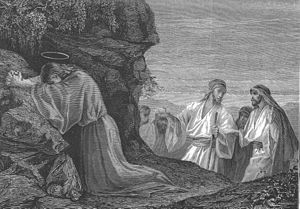 Image via Wikipedia But Paul quickly moves from praying for everyone in general to praying specifically for the King and all in authority. And that is a bit surprising. Most of our American presidents have been fellow believers in our miracle-working Lord and Savior Jesus. And even the others have not threatened to do things against the Church. But in Paul’s day, Emperor Nero would do things to hurt Christians (and others) for no good reason. In fact, both Peter and Paul would later be executed under Nero. Yet St. Paul says Christians in those days should ask God to bless this enemy of the Church – because God desires “desires all people to be saved and to come to the knowledge of the truth” (v. 4) through the “one mediator between God and men, the man Christ Jesus, who gave himself as a ransom for all” (v. 5-6). The same fully divine and fully human Jesus who did the work of sacrificing Himself for our salvation is today at work among us, speaking His blessed Word to God on our behalf – and speaking to us on God’s behalf.
  Image via Wikipedia
Now we as members of the Church join Jesus in His work. Sometimes our President, Governor, mayors, judges, legislators and council members speak well in representing us. Sometimes they harm us by their decisions. Whatever the case, God grant that we Christians speak for their benefit, praying to God in the name of Christ so that many more will blessed to know His true salvation.
What is some of the most important work of the Church that pleases God? When writing to encourage Pastor Timothy and his congregation in their life together, where does St. Paul begin? “First of all, then, I urge that supplications, prayers, intercessions, and thanksgivings be made for all people, for kings and all who are in high positions, that we may lead a peaceful and quiet life, godly and dignified in every way” (1 Timothy 2:1-2). Our prayers are to treat the needs and joys and sins of all other people as if they were our own. We ask God to help and forgive all, as well as give thanks to Him for the goodness He has shown them – with as much praise as we would give if the goodness were given to us.
 Image via Wikipedia
 Image via Wikipedia
Now we as members of the Church join Jesus in His work. Sometimes our President, Governor, mayors, judges, legislators and council members speak well in representing us. Sometimes they harm us by their decisions. Whatever the case, God grant that we Christians speak for their benefit, praying to God in the name of Christ so that many more will blessed to know His true salvation.

getting back to normal
after almost no normal weeks since June, I'm finally back to one today. No vacations, no conferences, no 3 day weekend. It's nice to get back to the routine, and hopefully back to the routine of posting here. I've thought about things I wanted to write from the daily devotions, but never got to the computer.
Last week was an excellent conference from Doxology, presented by John Kleinig and Hal Senkbeil (and Dr. Feuerhahn attended too, and contributed his always brilliant questions). It really got me thinking about improvements both to my preaching and my teaching, especially in the areas of Location (all types - physical and spiritual) and Imagination. "God did not give us our imaginations so we could imagine what is not, but what IS!" - Kleinig.
Anyway, if you know of a pastor in the New Jersey area, strongly urge them to attend this conference. Deadline for signing up is tomorrow.
Another DOXOLOGY Spotlight on Ministry Conference is coming up - spread the word to your pastor friends who live within driving distance of New Jersey. Hurry: registration deadline is September 21!
Last week was an excellent conference from Doxology, presented by John Kleinig and Hal Senkbeil (and Dr. Feuerhahn attended too, and contributed his always brilliant questions). It really got me thinking about improvements both to my preaching and my teaching, especially in the areas of Location (all types - physical and spiritual) and Imagination. "God did not give us our imaginations so we could imagine what is not, but what IS!" - Kleinig.
Anyway, if you know of a pastor in the New Jersey area, strongly urge them to attend this conference. Deadline for signing up is tomorrow.
Another DOXOLOGY Spotlight on Ministry Conference is coming up - spread the word to your pastor friends who live within driving distance of New Jersey. Hurry: registration deadline is September 21!
"Real Life Preaching/Helping People Entrapped in Porn"
Monday/Tuesday September 27/28, 2010
...Carmel Retreat Center Mahwah, New Jersey
Topics Covered:
Theophany in the Pulpit: Preaching as Disclosure of God’s gracious Presence
Preacher as Prophet: Sermon Strategy and Delivery
Confronting Pornography: Sexual Sanctification
Preaching the Real Presence of the Risen Lord Jesus
Preaching to Postmoderns: practicalities and applications
Sign up now!
http://www.doxology.us/Page.aspx?id=7
Sunday, September 12, 2010
September 10 - Philippians 2
I know, a bit late - but I can't shake the thought of wanting to post this:
Philippians 2:13 is rather astounding. And it made me think that this verse leads well into the "Our Father..." For God works in us the desire and the strength to do His will - even without our praying for Him to do so. But we pray "Thy Kingdom come, Thy will be done" that we may be led to realize this truth of Philippians 2:13 with thanksgiving.
Philippians 2:13 is rather astounding. And it made me think that this verse leads well into the "Our Father..." For God works in us the desire and the strength to do His will - even without our praying for Him to do so. But we pray "Thy Kingdom come, Thy will be done" that we may be led to realize this truth of Philippians 2:13 with thanksgiving.
Monday, September 6, 2010
September 6 - a little Luther for Labor Day on Psalm 127
interesting that this year the first Scripture verse you read from TDP on Labor Day is Psalm 127:1.
Below is something I got from Rev. William Cwirla through Rev. Charlie Mallie. I hand it out to all premarital couples who see me. Enjoy! (You might also like this Issues, etc. on the hymnody for today.)
Below is something I got from Rev. William Cwirla through Rev. Charlie Mallie. I hand it out to all premarital couples who see me. Enjoy! (You might also like this Issues, etc. on the hymnody for today.)
Martin Luther on Marriage and Home
An Exposition of Psalm 127
For the Christians at Riga in Livonia, LW 45:322-324
"Unless the Lord builds the house, those who build it labor in vain. Unless the Lord watches over the city, the watchman stays awake in vain."
First we must understand that "building the house" does not refer simply to the construction of walls and roof, rooms and chambers out of wood and stone. It refers rather to everything that goes on inside the house which we call "managing the household ...." Solomon's purpose is to describe a Christian marriage....
Reason and the world think that married life and the making of a home ought to proceed as they intend. They try to determine things by their own decisions and actions, as if their work could take care of everything. To this Solomon says No! He points us instead to God, and teaches us with a firm faith to seek and expect all such things from God. We see this in experience too. Frequently two people will marry who have hardly a shirt to their name, and yet they support themselves so quietly and well that it is a pleasure to behold. On the other hand, some bring great wealth into their marriage; yet it slips out of their hands till they can barely get along.
Again, two people marry out of passionate love; their choice and desire are realized, yet their days together are not happy. Some are very eager and anxious to have children, but they do not conceive, while others who have given the matter little thought get a house full of children. Again, some try to run the house and its servants smoothly, but it turns out that they have nothing but misfortune. And so it goes in this world; the strangest things happen.
Who is it that so disrupts marriage and household management and turns them so strangely topsy-turvy? It is he of whom Solomon says: Unless the Lord keeps the house, household management there is a lost cause. He wishes to buttress this passage and confirm its truth. This is why he permits such situations to arise in this world, as an assault on unbelief, to bring to shame the arrogance of reason with all works and cleverness, and to constrain them to believe.
This passage alone should be enough to attract people to marriage, comfort all who are now married, and sap the strength of covetousness. Young people are scared away from marriage when they see how strangely it turns out. They say, "It takes a lot to make a home"; or, "You learn a lot living with a woman." This is because they fail to see who does this, and why he does it. And since human ingenuity and strength know no recourse and can provide no help, they hesitate to marry. As a result, they fall into unchastity if they do not marry, and into covetousness and worry if they do. But here is the needed consolation: Let the Lord build the house and keep it, and do not encroach upon his work. The concern for these matters is his, not yours. For whoever is the head of the house and maintains it should be allowed to bear the burden of care. Does it take a lot to make a house? So what! God is greater than any house. He who fills heaven and earth will surely also be able to supply a house, especially since he takes the responsibility upon himself and causes it to be sung to his praise.
Why should we think it strange that it takes so much to make a home where God is not the head of the house? Because you do not see him who is supposed to fill the house, naturally every corner must seem empty. But if you look upon him, you will never notice whether a corner is bare; everything will appear to you to be full, and will indeed be full. And if it is not full, it is your vision which is at fault, just as it is the blind man's fault if he fails to see the sun. For him who sees rightly, God turns the saying around and says not, "It takes a lot to make a home," but, "How much a home contributes!" So we see that the managing of a household should and must be done in faith (then there will be enough) so that men come to acknowledge that everything depends not on our doing, but on God's blessing and support.
Thursday, September 2, 2010
September 1-7 - What Others Said on Ephesians
two posts in the same day - whoa. Anyway, last April I learned a lot listening to one of my sem Profs speak on Issues, etc. 24 about Ephesians. As we read through this book together this week, I think you will be extra blessed by the insights of Dr. Tom Winger. As for saying something of my own, within the last year I've started seeing Ephesians as Paul's letter about the Ascension. Chapter 1 is used on that day in the Church. But Chapter 2 includes this amazing bit: not only has Christ ascended, and not only did He by grace make us dead people into living people by His gracious gift of faith as the Ascended Christ comes to preach peace to you (whether in Ephesus or America), but He has ALREADY made you to ascend too! Raising YOU up NOW to be seated there in Heaven with Him today. Preaching on this text some years back, I adapted this bit from a sermon by Rev. William Cwirla:
Be astounded once again at all God’s undeserved gifts for you. And if you are not yet astounded, think of your being seated with Christ in the heavenly realms (Ephesians 2:6) in this way: It is not as though God is offering you tickets to Opening Day at Busch Stadium providing you straighten up and behave yourself. Nor is it as though you have to walk up to the Stadium box office to pick up the tickets on reserve for you. And it is not even like God put the tickets in your hand and you have to decide whether or not you go to the game. Your salvation is more like you are already at the game in Christ, with a drink in one hand and your food in the other – and you know that you do not deserve to be there. And yet there you are, and you do not want to be anywhere else in the world – and all you can do is thank the Man that got you there for free. Those who attend Opening Day will have to leave their seats. The game will come to an end after the final out – but your life in Christ, true Man and true God, never ends.Image via Wikipedia


September 1 - What another said about Joshua
Rev. Al Colver preached at the LCMS International Center on Joshua 24:14-28 yesterday a "sermon focused on Ebed Yahweh, "the servant of the Lord," Jesus who came to serve us. Because He has served us through his death and resurrection, we receive his forgiving gifts which spill out onto our neighbor. Jesus is our Joshua who led us through the waters of baptism into eternal life."
(You can see other unrelated material about Day 1 here. And rest assured, one of these days I will get back to posting my own meditations on TDP. Like about how August 31 had the beauty of pairing the widow's giving to Elijah with that of the Macedonian congregation's giving through Paul to Jerusalem's Christians. But I'm just back from Doxology again, after a summer interupted by vacations, and a lot of offline work needs attending to for the parishes.)
(You can see other unrelated material about Day 1 here. And rest assured, one of these days I will get back to posting my own meditations on TDP. Like about how August 31 had the beauty of pairing the widow's giving to Elijah with that of the Macedonian congregation's giving through Paul to Jerusalem's Christians. But I'm just back from Doxology again, after a summer interupted by vacations, and a lot of offline work needs attending to for the parishes.)
Subscribe to:
Posts (Atom)